Respectfully submitted by Meri Gibson, July 2026
Executive Summary.
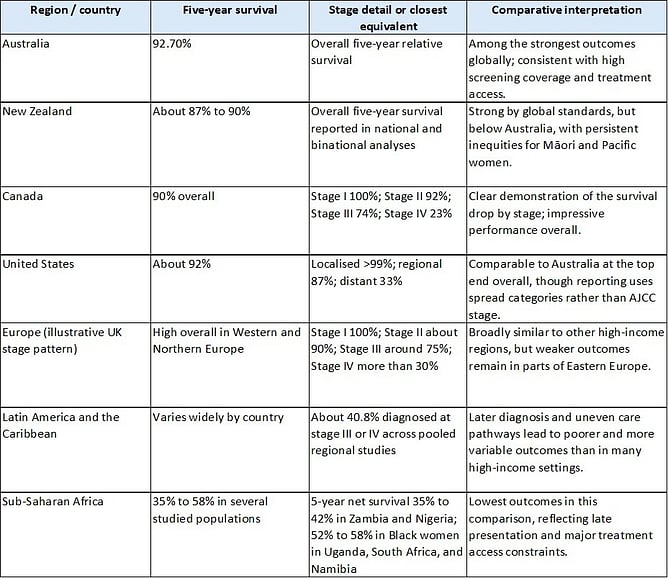
Breast cancer is usually the most commonly diagnosed cancer among women across major world regions, but outcomes differ sharply by region. Among the best reported five-year survival outcomes are seen in Australia, North America, and much of Western and Northern Europe, where organised screening, earlier diagnosis, and broad access to multimodal treatment support strong outcomes. Australia reports 92.7% five-year survival, the United States about 92%, Canada 90%, and New Zealand estimates vary by source and cohort, commonly falling around 87% to 90%. Europe also performs strongly overall, although outcomes are less favourable in parts of Eastern Europe. By contrast, Latin America, and the Caribbean and much of Africa carry a higher mortality burden relative to incidence because more women present with advanced disease and treatment access is less consistent.
Stage at diagnosis is the clearest determinant of survival across every continent. Early-stage disease has excellent outcomes, stage II remains strong, stage III falls materially, and stage IV remains poor. Regional evidence illustrates the gap: a systematic review found that 40.8% of women in Latin America and the Caribbean are diagnosed at stage III or IV, while recent prospective evidence from sub-Saharan Africa found five-year net survival of about 35% to 42% in Zambia and Nigeria and about 52% to 58% in Black women in Uganda, South Africa, and Namibia. In whole-population comparisons, breast cancer often sits behind prostate cancer and, in some settings, lung cancer, while remaining ahead of colorectal cancer; in women-only comparisons, it is usually the leading cancer by incidence.
This report compares breast cancer survival across selected countries and regions and highlights how stage at diagnosis shapes outcomes. Because sources use different staging systems and reporting methods, figures are not perfectly equivalent. Canada provides national stage-specific net survival, the United States reports survival by extent of spread rather than AJCC stage, and New Zealand, Latin America, and sub-Saharan Africa are presented using the best available national or regional evidence.
Global position: Breast cancer is usually the most commonly diagnosed cancer among women across Oceania, North America, Europe, Latin America, and much of Africa, although regional and subregional rankings vary.
Strongest survival: Five-year survival is among the highest in Australia, North America, and much of Western and Northern Europe.
Illustrative benchmarks: Australia 92.7%; United States about 92%; Canada 90%; New Zealand estimates vary by source and cohort, commonly around 87% to 90%.
Main driver of variation: Survival declines materially with later stage at diagnosis, making earlier detection and timely treatment the central levers for improvement.
Regions under greatest pressure: Latin America and the Caribbean and much of sub-Saharan Africa face later diagnosis and weaker access to complete treatment, resulting in poorer outcomes.
Policy implication: The largest gains are likely to come from improving early diagnosis, equitable access to multimodal treatment, and survivorship support.
Five Year Survival Comparison by Country and Region
Continent-by-Continent Incidence Ranking
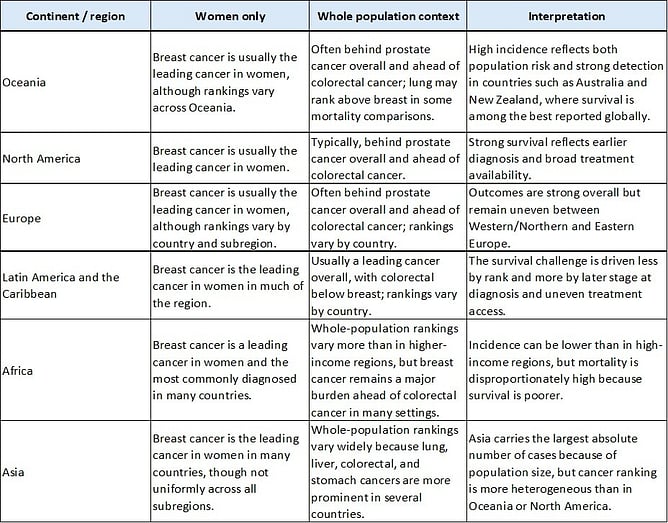
Ranking note: Statements about whether breast cancer sits behind prostate and sometimes lung cancer but ahead of colorectal cancer depend on whether incidence is being discussed for women only or for the entire population. In women, breast cancer is usually the leading cancer by incidence across major world regions, but regional and sub-regional rankings vary. In whole-population comparisons, prostate cancer often ranks first in countries with high male cancer incidence, breast cancer commonly follows, and colorectal cancer usually sits below breast cancer. By mortality, lung cancer frequently exceeds breast cancer in women and in whole-population comparisons in several countries.
Recommendation: Survivorship strategies should extend beyond diagnosis and treatment to include structured opportunities for physical activity, peer connection, and visible community advocacy. In this context, breast cancer dragon boating offers more than recreation: it provides a practical platform for rehabilitation, confidence, social support, and public awareness. The International Breast Cancer Paddlers Commission promotes participation, inclusiveness, connection, strength, support, and advocacy — values that align closely with the needs of survivors, particularly in regions where health systems are still working to improve early detection, equitable treatment access, and long-term survivorship support.
Accordingly, policymakers, clinicians, survivor organisations, and community partners should consider advocacy and dragon boat development as part of a broader survivorship model. The IBCPC history notes that the movement challenges the notion that breast cancer survivors should avoid strenuous upper-body exercise. In early 2026, the IBCPC represents more than 410 teams across 43 countries, illustrating that this model is scalable, inclusive, and internationally relevant. Supporting team formation, access to paddling opportunities, and public-facing awareness events can therefore complement clinical care by strengthening recovery, reducing isolation, and demonstrating that life after breast cancer can be active, connected, and purposeful.
References
American Cancer Society. 2024. Survival Rates for Breast Cancer. Updated 5 October 2024.
Breast Cancer Foundation NZ. 2026. Breast Cancer in NZ. Accessed June 2026.
Breast Cancer Foundation National Register. 2026. Register Statistics; 30,000 Voices: Informing a Better Future for Breast Cancer in Aotearoa New Zealand. Accessed June 2026.
Cancer Australia. 2025. Breast Cancer in Australia Statistics. Updated 4 December 2025.
Canadian Cancer Society. 2023. Survival Statistics for Breast Cancer. Last medical review August 2023.
Ellison LF, Saint-Jacques N. 2023. Five-Year Cancer Survival by Stage at Diagnosis in Canada. Health Reports 34(1): 3–15. Statistics Canada.
International Breast Cancer Paddlers Commission. 2026. About IBCPC.
International Breast Cancer Paddlers Commission. 2026. Our History.