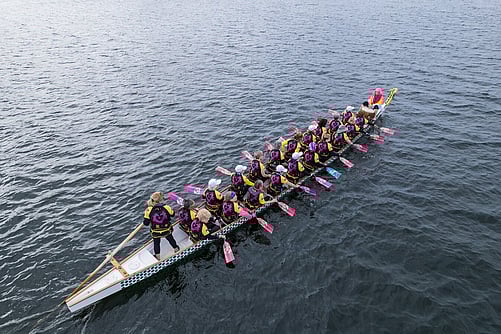
We all know that how we are training and the coaching that you are receiving is on the right track. It now comes down to how much you want to become better, what you want to achieve. Ultimately though it is about individual growth and teamwork. So, here are some reminders of what we have been learning and how to improve on what we are doing.
To enhance paddling skills, it is essential to comprehend the integration of body mechanics, blade mechanics, and stroke mechanics. This understanding is crucial for improving power, efficiency, and team coordination on the water, leading to a smoother boat glide and greater stroke effectiveness.
Firstly, proper body mechanics are fundamental in boosting power and glide. By maintaining correct body alignment and movement in harmony with the boat's trajectory, one can maximize stroke power and achieve effortless boat glide, thereby enhancing team synchronization.
Secondly, blade mechanics play a vital role in optimising water connection. Ensuring correct blade angles and alignment reduces drag and increases stroke effectiveness by maintaining powerful contact with the water throughout each stroke phase.
Lastly, stroke mechanics are essential for enhancing overall performance. Coordinated stroke sequencing is necessary to maintain efficient boat glide, while an effective stroke setup allows for the transfer of maximum body weight, generating more power with less effort.
Team coordination is a critical aspect of paddling that significantly impacts overall performance and efficiency on the water. Achieving team coordination in paddling can be quite challenging due to several factors:
Individual Skill Levels:
Each team member may have various levels of experience and skill. This disparity can make it difficult to synchronise movements and maintain a consistent paddling rhythm. Experienced paddlers might have to adjust their technique to match that of beginners, which can affect overall performance.Communication:
Effective communication is essential for team coordination. Without clear and timely communication, it can be challenging to ensure that all team members are on the same page regarding stroke timing, power, and technique. Miscommunication can lead to disjointed paddling and reduced efficiency.Physical Synchronisation:
Coordinating physical movements among multiple paddlers requires precise timing and alignment. Even slight variations in body movement or paddle angle can disrupt the harmony of the team, leading to inefficient strokes and increased drag.Mental Focus:
Maintaining mental focus and concentration is crucial for team coordination. Paddlers need to be aware of their own movements as well as those of their teammates. Distractions or lapses in concentration can result in loss of synchronization and decreased performance.Environmental Factors:
External conditions such as wind, waves, and currents can impact team coordination. Paddlers must adapt to these changing conditions while still maintaining synchronisation, which can be challenging and require quick adjustments.Fatigue:
Physical fatigue can affect coordination and performance. As paddlers become tired, their movements may become less precise, leading to a breakdown in synchronisation. Managing energy levels and ensuring adequate rest is important for maintaining team coordination.
However, when team members are well-coordinated, they can achieve a harmonious and synchronised paddling rhythm, which leads to several key benefits. The benefits of team coordination are:
Enhanced Boat Glide:
When all team members move their bodies in linear alignment and with the boat's trajectory, it creates synchronicity. This synchronicity results in a boat that moves with ease and effortlessness on the water, enhancing the overall glide of the boat.Maximised Stroke Power:
Proper body alignment and movement in harmony with the boat's trajectory ensure that each paddler is transferring the maximum amount of body weight onto the paddle. This maximizes stroke power and allows the team to pull water with greater strength, leading to more effective and powerful strokes.Reduced Drag and Increased Efficiency:
Correct blade angles and alignment reduce drag and increase stroke effectiveness by ensuring powerful contact with the water throughout each stroke phase. This optimisation of water connection allows the boat to glide forward more smoothly and efficiently.Consistent Boat Glide:
Coordinated stroke sequencing among team members helps maintain a constant and efficient boat glide. When each component of the stroke (the catch, the pull, the exit, and the recovery) is synchronised, the boat moves forward without interruptions, resulting in a more fluid and efficient motion.Effective Stroke Setup:
An effective stroke setup allows for the transfer of maximum body weight, generating more power with less effort. This setup includes proper grip on the paddle, foot position, and body momentum, all of which need to be aligned and ready to generate as much force as possible.
In summary, team coordination is essential for achieving a smooth and efficient paddling experience. It enhances boat glide, maximizes stroke power, reduces drag, and ensures consistent and effective strokes. By working together in harmony, we as team members can significantly improve our overall performance on the water.